PDF stands for Portable Document Format. A PDF file preserves the formatting, fonts, layout, and images of a document so that it looks the same on different devices and operating systems.
If you are trying to convert a Word, Excel, or PowerPoint file to PDF, there are multiple ways to do it depending on your Office and Windows version. In this guide, you’ll learn the correct and updated methods to create PDF files using Microsoft Office and Windows.
Method 1: Use “Save As PDF” in Microsoft Office (Recommended)
Modern versions of Microsoft Office include a built-in option to save documents directly as PDF.
This feature is available in:
- Office 2010
- Office 2013
- Office 2016
- Office 2019
- Office 2021
- Microsoft 365
Steps to Save as PDF
- Open your document in Word, Excel, or PowerPoint.
- Click File.
- Click Save As.
- Choose the location where you want to save the file.
- From the file type dropdown menu, select PDF (*.pdf).
- Click Save.
You can also use:
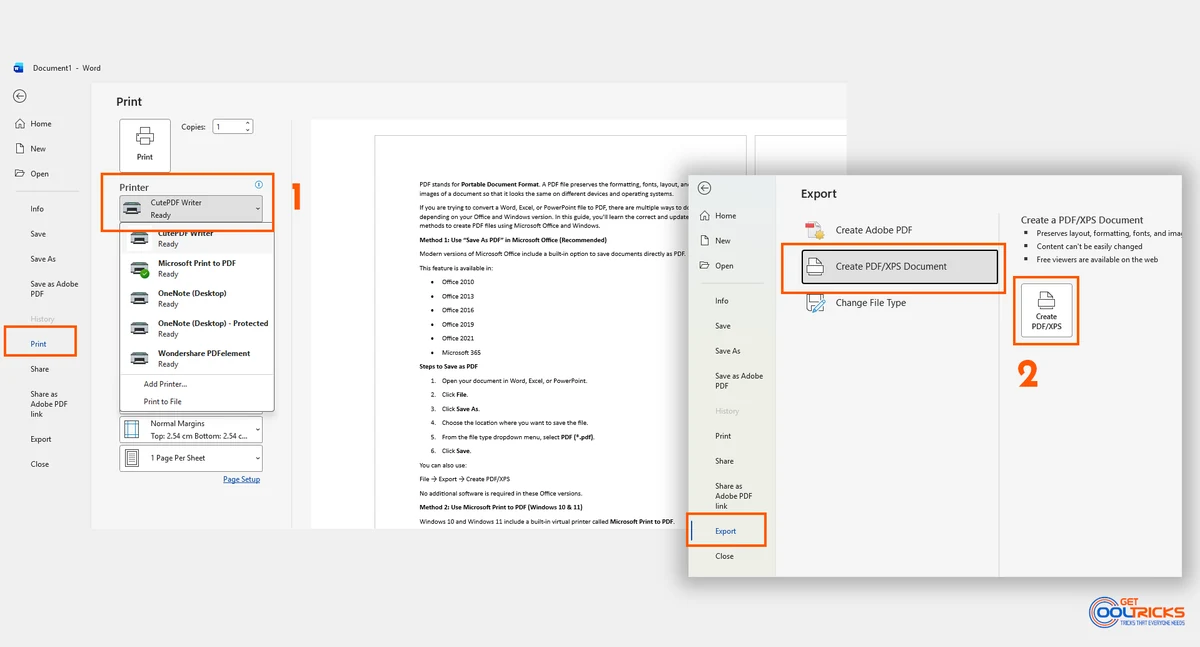
File → Export → Create PDF/XPS
No additional software is required in these Office versions.
Method 2: Use Microsoft Print to PDF (Windows 10 & 11)
Windows 10 and Windows 11 include a built-in virtual printer called Microsoft Print to PDF.
This is a Windows feature, not an Office feature. It works with any software that supports printing.
Steps to Print a File as PDF
- Open your document.
- Press Ctrl + P or go to File → Print.
- In the Printer selection list, choose Microsoft Print to PDF.
- Click Print.
- Select the folder where you want to save the file.
- Enter a file name and click Save.
Windows will create a PDF file instead of sending the document to a physical printer.
This method works for:
- Microsoft Office documents
- Web pages
- Images
- Text files
- Any application that supports printing
What If “Save as PDF” Is Not Available?
Very old versions of Microsoft Office (such as early Office 2007 releases) did not include built-in PDF support.
Microsoft originally provided an official “Save as PDF or XPS” add-in for Office 2007. However, this add-in is no longer officially distributed by Microsoft.
If you are using an older Office version without PDF support, you have the following options:
Option 1: Use Microsoft Print to PDF (If on Windows 10/11)
If your system runs Windows 10 or Windows 11, simply use Microsoft Print to PDF as explained above.
This is the safest and easiest solution.
Option 2: Use a Lightweight PDF Printer Like CutePDF
If you are using an older Windows version that does not include Microsoft Print to PDF, you can install a lightweight virtual PDF printer such as CutePDF Writer.
CutePDF works by installing a virtual printer driver.
Basic Steps After Installing CutePDF
- Install CutePDF Writer.
- Open your document.
- Press Ctrl + P or go to File → Print.
- Select CutePDF Writer as the printer.
- Click Print.
- Choose the save location and file name.
- Click Save.
CutePDF will generate a PDF file instead of printing to paper.
This method works with almost any software that has a Print option.
When Do You Need Third-Party PDF Software?
For basic PDF creation, the built-in tools in Microsoft Office and Windows are more than sufficient.
However, you may need dedicated PDF software if you want to:
- Edit PDF content directly
- Convert PDF files back to Word or Excel
- Merge multiple PDF files
- Add passwords or encryption
- Use OCR (Optical Character Recognition) on scanned documents
In such cases, you can consider professional tools such as:
- Adobe Acrobat
- Wondershare PDFelement
- Nitro PDF
- Foxit PDF Editor
For example, Adobe Acrobat integrates directly into Microsoft Office and adds a dedicated “Create PDF” or “Save as Adobe PDF” option inside the Office ribbon. This allows you to generate optimized PDF files with additional security and editing options. These tools are optional and mainly useful for advanced PDF editing and document management.
For most users:
- Use Save As → PDF inside Office.
- Or use Microsoft Print to PDF in Windows 10 or Windows 11.
- On older systems, use a lightweight virtual printer like CutePDF.
There is no need to install heavy third-party software just to create a basic PDF file. With these methods, you can easily convert Word, Excel, PowerPoint, web pages, or images into PDF format while preserving layout and formatting.