Have you ever thought about what happens if your hard drive suddenly fails?
Most of us don’t think about it until something goes wrong. By then, files are already gone — and not everything can be recovered from the Recycle Bin or a restore point.
That’s where Storage Spaces comes in. It’s a built-in Windows feature that helps protect your data by keeping copies of your files across multiple drives.
What is Storage Spaces?
Storage Spaces is a feature available in Windows (introduced in Windows 8 and still available in Windows 10 and Windows 11).
It lets you combine multiple drives into a single storage pool and create a virtual drive from it.
The main advantage?
Your data can be stored in multiple copies. So even if one drive fails, your files are still safe on another.
What You Need
Before setting this up, you’ll need:
- At least two additional drives (internal or external)
- These should not include your main Windows drive
You can use:
- Internal HDDs or SSDs
- External USB drives
How to Create a Storage Space
Important: All data on the selected drives will be erased. Make sure to back up anything important first.
Steps:
- Connect the drives you want to use
- Open Start and search for Storage Spaces
- Click Manage Storage Spaces
- Click Create a new pool and storage space
- Select the drives you want to include
- Click Create pool
Now configure your storage space:
- Give it a name and drive letter
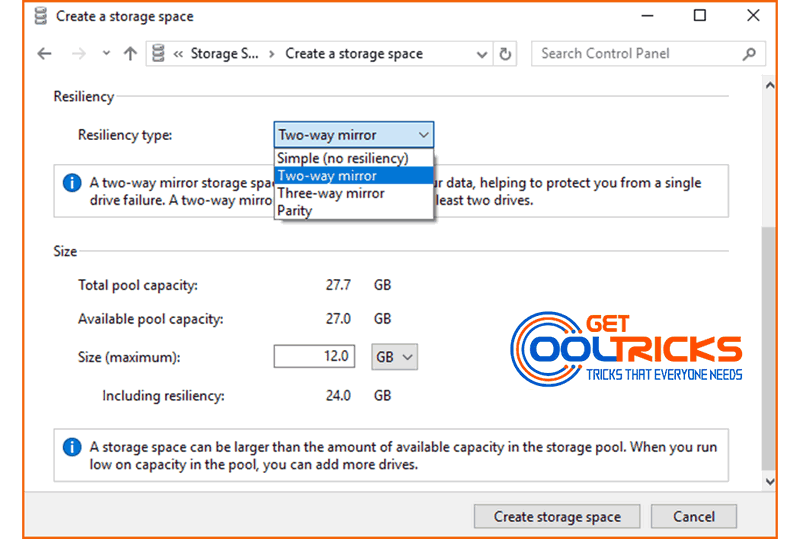
- Choose a resiliency type
- Set the maximum size
- Click Create storage space
Once done, it will appear like a normal drive under This PC.
Understanding Resiliency Types
When creating a storage space, you’ll see different options. Here’s what they mean:
Simple (No Protection)
This mode focuses on performance and uses the full capacity of your drives.
- No protection from drive failure
- Best for temporary files or non-important data
Not recommended for backups
Mirror (Recommended)
This is the most practical option for most users.
- Keeps multiple copies of your data
- Protects against drive failure
- Works with just two drives
Types:
- Two-way mirror → keeps 2 copies
- Three-way mirror → keeps 3 copies
This is the best choice for most setups
Parity
This is more space-efficient but slightly slower.
- Suitable for large files like videos and archives
- Requires at least 3 drives
- More complex than mirror
Good for media storage, not everyday use
How to Use Storage Spaces
Once created, your storage space behaves like a normal drive.
You can:
- Copy files
- Install apps
- Store documents
There’s no difference in daily use — everything works the same way.
Important Things to Keep in Mind
- If one drive fails, your data is still safe (depending on setup)
- If multiple drives fail (beyond the protection level), data can be lost
- Deleting a storage space will remove all data in it
- It’s still a good idea to keep a separate backup for critical files
Final Thoughts
Storage Spaces is one of those features that most people ignore, but it can save you a lot of trouble.
Instead of relying on a single drive, you’re spreading your data across multiple drives. That alone reduces the risk of losing everything at once.
If you have spare drives lying around, it’s definitely worth setting this up — especially if you’re storing important files.