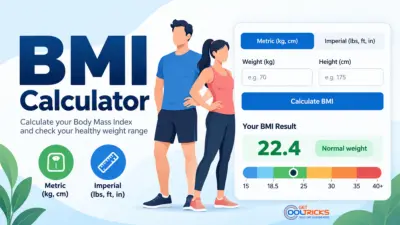
Your Body Mass Index (BMI) is a simple way to check whether your weight falls within a generally healthy range for your height. Healthcare professionals often use it as an initial screening tool to identify possible weight-related health risks.
Use our free BMI calculator to check your BMI. You can enter your measurements in kilograms and centimetres or pounds, feet and inches. The result shows your BMI category and estimated healthy weight range. This calculator is designed for adults aged 20 and above.
BMI Calculator
Enter your height and weight to calculate your Body Mass Index (BMI).
Your BMI
BMI is a screening tool and not a diagnosis of health. It does not directly measure body fat or account for differences in muscle mass, bone density or fat distribution. Consult a healthcare professional for a complete assessment.
What Is BMI (Body Mass Index)?
BMI stands for Body Mass Index. It is a number calculated using your height and weight. The result gives you a general idea of whether you are underweight, within the healthy weight range, overweight or have obesity.
BMI is widely used because it is easy to calculate and doesn't require special equipment. However, it doesn't measure body fat directly or tell you everything about your health. It is best treated as a starting point for understanding your weight.
How to Calculate BMI
You can calculate BMI using metric or imperial measurements. The formula depends on the units you use.
Metric formula (kg and cm)
BMI = Weight (kg) ÷ Height (m)²
Convert your height from centimetres to metres before calculating.
Example: If your weight is 75 kg and your height is 175 cm (1.75 m):
BMI = 75 ÷ (1.75 × 1.75)
BMI = 24.49
Imperial formula (lbs, feet and inches)
BMI = [Weight (lbs) ÷ Height (inches)²] × 703
First, convert your height into inches. One foot equals 12 inches.
Example: If your weight is 165 lbs and your height is 5 feet 9 inches:
Height = (5 × 12) + 9 = 69 inches
BMI = (165 ÷ 69²) × 703
BMI = 24.36
Our calculator handles these calculations automatically, so you don't need to convert the measurements yourself.
Adult BMI Chart
The following categories are used to interpret BMI in adults aged 20 and above.
| BMI range (kg/m²) | Category |
|---|---|
| Below 18.5 | Underweight |
| 18.5–24.9 | Healthy weight |
| 25.0–29.9 | Overweight |
| 30.0–34.9 | Obesity – Class 1 |
| 35.0–39.9 | Obesity – Class 2 |
| 40.0 and above | Obesity – Class 3 |
These are the standard international adult BMI categories used by the World Health Organization (WHO) and the Centers for Disease Control and Prevention (CDC).
What Is a Healthy BMI?
For most adults, a BMI between 18.5 and below 25 is considered within the healthy weight range.
You can also estimate a healthy weight range using your height:
- Minimum weight: 18.5 × height (m)²
- Upper limit: 25 × height (m)²
For someone who is 175 cm tall, this works out to approximately 56.7 kg to less than 76.6 kg.
Remember that this is a general reference, not a target weight for everyone. Muscle mass, body structure, and overall health can also influence what weight is suitable.
How Accurate Is BMI?
BMI is a useful screening tool, but it has some limitations.
- Muscle mass: People with more muscle may have a higher BMI even without excess body fat.
- Fat distribution: BMI cannot tell where fat is stored. Waist circumference can provide additional information.
- Individual differences: Age, ethnicity and body composition can affect how BMI should be interpreted.
BMI for Asian populations
Some Asian populations may face a higher risk of conditions such as type 2 diabetes at lower BMI values. Because of this, certain health guidelines use additional BMI action points of 23 and 27.5.
These are additional health-risk thresholds, not replacements for the standard international categories used in this calculator. If you are of Asian background, consider discussing your BMI and other risk factors with a healthcare professional.
Frequently Asked Questions
1. What is a normal BMI for adults?
A BMI between 18.5 and below 25 is generally considered within the healthy weight range for adults aged 20 and above.
2. Is BMI different for men and women?
No. The standard BMI formula and categories are the same for both. However, BMI does not account for differences in muscle mass or body fat distribution.
3. Can I calculate BMI using pounds and inches?
Yes. Use the imperial formula: (Weight in pounds ÷ Height in inches²) × 703. Our calculator supports both metric and imperial units.
4. Does age affect BMI?
The standard adult BMI categories apply from age 20 onwards. Children and teenagers use a different method that considers age and sex.
5. Can someone have a high BMI and still be healthy?
Yes. People with higher muscle mass may have a higher BMI without having excess body fat. Other measurements are needed to get a clearer picture of their health.
6. Can I use BMI during pregnancy?
Standard BMI categories are not designed to assess weight changes during pregnancy. Speak with your healthcare professional for appropriate guidance.
References
The information in this article is based on guidance from the following health organisations:
- World Health Organization (WHO): Obesity and overweight
- Centers for Disease Control and Prevention (CDC): Adult BMI Categories
- Centers for Disease Control and Prevention (CDC): About Body Mass Index
- Health Canada: Canadian Guidelines for Body Weight Classification in Adults
Medical disclaimer: BMI is a screening tool, not a medical diagnosis. This calculator is intended for general information and should not replace advice from a qualified healthcare professional.