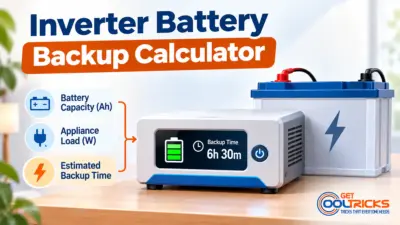
Wondering how long your inverter battery will power your appliances during a power cut? Our Inverter Battery Backup Calculator helps you estimate the backup time based on your appliances, battery capacity, and inverter efficiency.
Select the appliances you want to run, enter your battery details, and calculate the estimated backup time. You can also add custom appliances and use different battery voltages, including 12V, 24V, 48V, and higher-voltage battery banks.
How to Use the Inverter Battery Backup Calculator
- Select the appliances you want to run and enter their wattage and quantity.
- Add any other appliances that are not included in the list.
- Enter your battery bank voltage and capacity in Ah.
- Select the battery type and adjust the advanced settings if required.
- Click Calculate Battery Backup to see the estimated backup time.
The calculator also shows the total appliance load, usable battery energy, estimated current draw, and recommended battery capacity for your required backup duration.
1. Select your appliances
Choose the appliances you plan to run during a power cut. Adjust their wattage and quantity as required.
Wattage values are typical estimates. Check the appliance label or manufacturer’s specifications for more accurate values.
2. Battery details
Enter the total voltage and Ah capacity of the complete battery bank. For series connections, voltage increases while Ah remains the same.
Advanced settings
Default usable capacity is 50% for lead-acid and 80% for lithium-ion batteries.
Estimated runtime with your selected appliances.
This is an approximate estimate. Actual backup time depends on battery condition, temperature, discharge rate and inverter performance.
This calculator provides an estimate based on the values entered. Actual backup time depends on multiple operational parameters.
How Is Inverter Battery Backup Time Calculated?
Battery backup time depends mainly on three things: battery capacity, connected appliance load, and inverter efficiency.
The calculator uses the following formula:
Backup Time (hours) = (V × Ah × DoD × η) ÷ W
Where:
- V: Battery bank voltage
- Ah: Battery capacity in ampere-hours
- DoD: Usable battery discharge percentage
- η: Inverter efficiency
- W: Total appliance power consumption in watts
For example, consider a 12V, 150Ah lead-acid battery with a 50% usable discharge limit and an inverter efficiency of 85%. If the connected appliances consume 300 watts, the estimated backup time is approximately 2 hours and 33 minutes.
Actual backup time may vary depending on battery condition, temperature, and power consumption.
What Is the Difference Between Regular and BLDC Fans?
Regular ceiling fans generally consume around 70–80 watts, while BLDC fans commonly consume around 25–35 watts, depending on the model and operating speed.
Since BLDC fans use less electricity, they can reduce the total load on your inverter and provide longer battery backup.
You can select both regular and BLDC fans in the calculator and adjust their wattage to match your actual appliances.
How Does Battery Voltage Affect Backup Time?
Inverter systems commonly use 12V, 24V, and 48V battery configurations. Larger systems may use higher DC voltages.
When identical batteries are connected in series, their voltages add up while the Ah capacity remains unchanged. For example, twelve 12V, 150Ah batteries connected in series form a 144V, 150Ah battery bank.
When batteries are connected in parallel, the voltage remains the same while the Ah capacity increases.
Always make sure the battery bank voltage matches the inverter’s specified DC input voltage.
Frequently Asked Questions
How many hours will a 150Ah inverter battery last?
Backup time depends on the battery voltage, connected load, usable discharge capacity, and inverter efficiency. A 12V, 150Ah lead-acid battery with a 50% discharge limit and 85% inverter efficiency provides approximately 765Wh of usable AC energy.
How much backup can I get from a BLDC fan?
A 28W BLDC fan consumes considerably less power than a regular 75W ceiling fan. The actual backup time depends on the battery capacity and other appliances connected to the inverter.
Which is better for an inverter, a lead-acid or lithium-ion battery?
Lead-acid batteries are commonly used in home inverter systems and are generally less expensive initially. Lithium-ion batteries can offer higher usable capacity, lower maintenance, and longer cycle life, but their cost and inverter compatibility should be considered.
Does a higher Ah battery provide more backup time?
Yes. At the same voltage and discharge settings, a battery with a higher Ah rating stores more energy and generally provides longer backup time for the same appliance load.
Can I connect multiple batteries to increase backup time?
Yes. Batteries can be connected in series or parallel to configure the required battery bank. However, the voltage and capacity must be compatible with the inverter. Use batteries of matching specifications and follow the manufacturer’s installation instructions.
Why is my actual battery backup lower than the calculated result?
Battery age, temperature, discharge rate, inverter losses, and appliance starting currents can all affect actual backup time. Lead-acid batteries, in particular, may deliver less than their rated capacity under heavy loads.
The calculator provides an estimate based on the values entered, not a guaranteed runtime.